
Direct answer: Invisalign reliably corrects mild-to-moderate crowding, spacing, and some bite issues — but it can’t fix everything. Severe bite problems, major vertical movements, and complex rotations often need braces or other approaches. Expect 6–18 months of treatment, a likely refinement round, and lifetime retainer wear to keep the result.
Key takeaways
- Aligners excel at mild-to-moderate crowding, gaps, and some bite correction — not severe or complex cases.
- Refinements (extra tray rounds) are normal, not a sign of failure — 30–50% of patients need them.
- Treatment typically runs 6–18 months, plus refinements; lifetime retainers protect the result.
- If your case involves severe bite issues or major vertical movement, braces may deliver better results for less money.
- The biggest predictor of a good outcome isn’t the brand — it’s wearing the trays 20–22 hours a day.
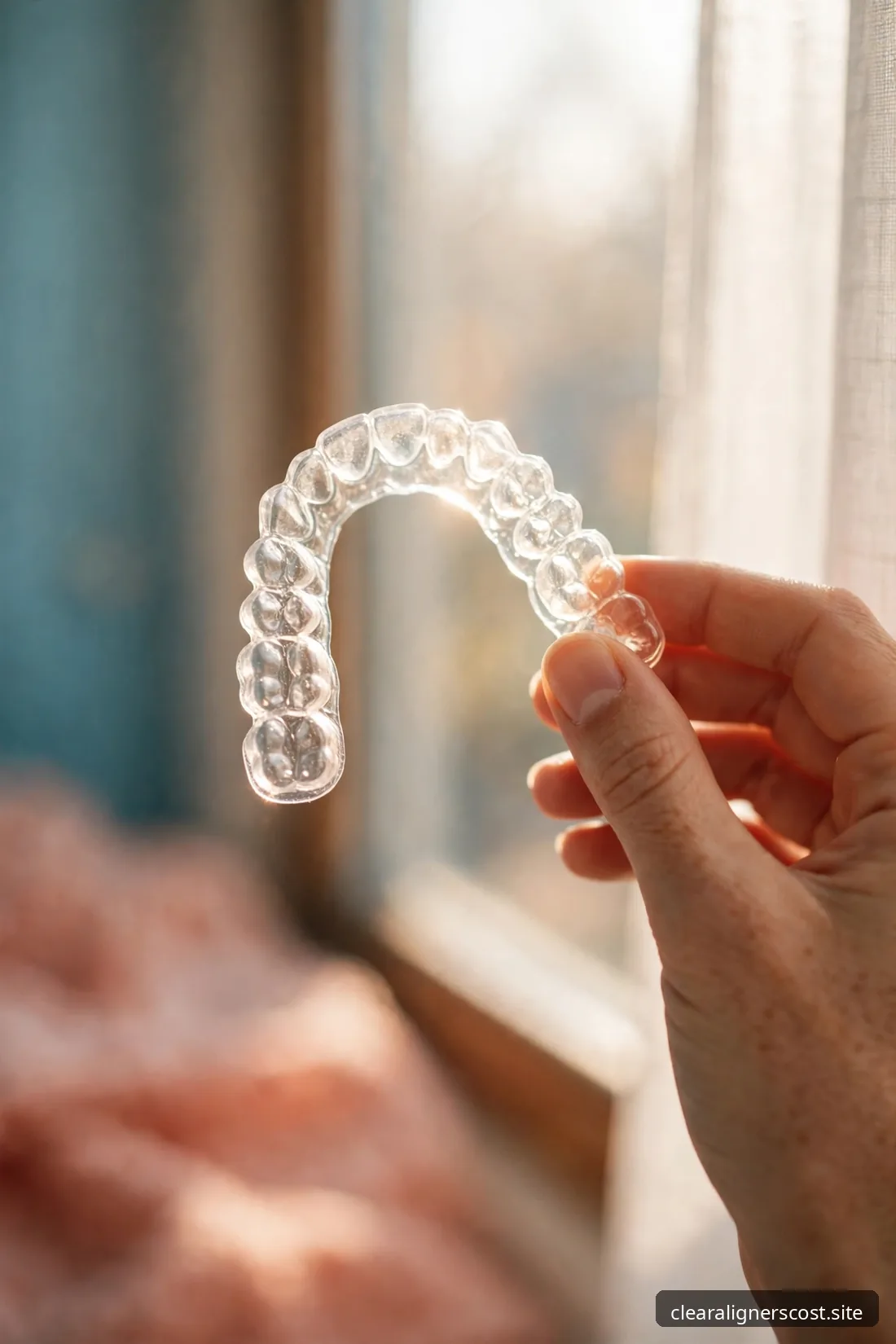
What aligners do genuinely well
Clear aligner technology has matured enormously. For the right cases, results are excellent and well-documented:
Mild to moderate crowding. The classic Invisalign case — overlapping or rotated front teeth with enough space to work with. This is where aligners shine, often finishing in 6–12 months.
Spacing and gaps. Diastemas (gaps between teeth) close predictably with aligners, including the familiar gap between the front teeth.
Mild to moderate bite issues. Many overbites, underbites, and crossbites in the mild-to-moderate range respond well, especially when combined with attachments — the small tooth-colored bumps bonded to teeth that give trays extra grip for difficult movements.
Relapse retreatment. Teeth that shifted after teenage braces are often ideal aligner cases: the movements needed are small and well-defined.
Adult cases generally. There’s no age limit on tooth movement. Adults with healthy gums and bone are routinely treated with aligners, and the discretion factor matters more to working adults than to anyone.
If this sounds like your situation, the next step is understanding the full Invisalign treatment process — what the appointments, scans, and tray changes actually involve.
What aligners struggle with
Honesty requires the other half of the picture. Aligners move teeth with plastic pushing on enamel — a fundamentally less precise force system than brackets and wires. Known limitations:
Severe bite discrepancies. Significant Class II (severe overbite) or Class III (severe underbite) cases often need the precise, continuous force control that only fixed braces — sometimes with elastics or other auxiliaries — provide.
Major vertical movements. Extruding teeth (pulling them down/out of the gum) or large intrusion movements are among the least predictable aligner movements. Open bites and deep bites needing major vertical correction frequently do better with braces.
Large rotations. Rotating a tooth more than about 20 degrees — especially round teeth like premolars — is difficult for a smooth plastic tray to grip, even with attachments.
Short or oddly shaped teeth. Trays need surface area to push against. Very short clinical crowns give the plastic little to hold.
Complex multi-directional cases. When teeth need to move in several directions at once while the bite is also being corrected, treatment planning gets complicated and refinement rounds multiply.
None of this means aligners “don’t work” — it means case selection matters enormously. A good provider will tell you when your case exceeds what aligners do well. A provider who promises any outcome to anyone is selling, not treating.
When braces are honestly the better choice
This is the comparison patients often don’t get at a free aligner consultation — for obvious reasons. Braces are genuinely superior in specific situations:
- Severe crowding with extractions needed. Braces handle extraction-space closure more predictably.
- Significant jaw discrepancies. Sometimes the issue is skeletal, not dental — no tray or bracket moves jawbone in adults. These cases may need surgical consultation.
- Patients who won’t wear trays 20–22 hours daily. This is the honest one. Braces work 24/7 with zero compliance required. If your lifestyle — constant travel, client entertainment, irregular meals — makes disciplined wear unrealistic, braces may deliver a better result for less total cost.
- Teenagers with compliance concerns. Removable means losable and skippable. Some teens do great; others need the non-negotiable nature of fixed braces.
- Budget-constrained complex cases. When a complex case needs aligners plus multiple paid refinement rounds, the total can exceed braces. Braces typically cost $2,500–$7,000 all-in with refinements effectively included.
Our detailed Invisalign vs. braces comparison breaks down cost, comfort, and results side by side.
Refinements: the normal middle chapter
A refinement is an additional set of aligners ordered when teeth haven’t moved exactly as the original plan predicted. Here’s what the marketing doesn’t emphasize: refinements are normal, not failure. An estimated 30–50% of patients need at least one refinement round.
Common reasons refinements happen:
- Teeth that didn’t track the plan (often a compliance issue — trays worn 16 hours instead of 22)
- Stubborn teeth that need a different attachment strategy
- Bite settling that needs fine-tuning at the end
- The provider deliberately planning in two phases for a complex case
The cost question: Invisalign Comprehensive typically includes unlimited refinements within the original treatment timeframe. Lower tiers (Lite, Moderate, Express) include limited rounds — refinements beyond that cost extra, commonly $500–$2,500 per round. This is one of the most important fine-print items in any quote: ask exactly how many refinement rounds are included and what happens if you need more.
The time question: each refinement round adds weeks to months. A “12-month treatment” that needs two refinement rounds can easily become 18 months. That’s still a good outcome — it just isn’t the brochure timeline.

The timeline reality
Advertised timelines (“straight teeth in 6 months!”) describe best cases. Realistic ranges:
| Case type | Typical tray count | Realistic timeline |
|---|---|---|
| Minor touch-up / Express | 7–14 trays | 3–6 months |
| Mild crowding or spacing | 14–25 trays | 6–9 months |
| Moderate comprehensive | 25–40 trays | 9–15 months |
| Complex comprehensive | 40+ trays, likely refinements | 15–24 months |
Each tray is typically worn 1–2 weeks. But the calendar math that matters includes refinement rounds, the occasional backtrack when a tray doesn’t track, and real life — vacations, forgotten trays, busy months. Most patients should mentally add 20–30% to the quoted timeline.
For a deeper dive, our guide to how long Invisalign takes covers every factor that speeds treatment up or slows it down.
Relapse: why results need maintenance
The before-and-after photos stop at “after.” Real life continues — and teeth keep experiencing forces from chewing, grinding, tongue pressure, and aging. Without retention, teeth drift. This is true after aligners, after braces, after any orthodontic treatment.
The maintenance contract is simple:
- Wear retainers as directed — full-time for 6–12 months post-treatment, then nightly indefinitely.
- Replace retainers when they wear out — budget $200–$400/year for clear retainers.
- Keep up dental checkups — your dentist spots shifting early, when it’s cheap to address.
Patients who follow this keep their results for decades. Patients who don’t often find themselves researching orthodontics a second time in their 30s or 40s — at full price. Our retainer cost guide lays out the lifetime math so you can budget for it from day one.
How to judge your own case
You can’t diagnose your own orthodontic case — but you can walk into a consultation informed. Useful signals:
Likely straightforward: mild crowding of front teeth, small gaps, minor relapse after past braces, no bite pain or jaw issues.
Likely complex: severe overlapping, teeth that don’t meet properly, jaw pain or clicking, previous extractions with shifting, significant overbite or underbite.
Questions to ask at your consultation:
– Is my case mild, moderate, or complex — and what makes it so?
– Are there movements here that aligners handle poorly?
– Would braces give a better result in my case? (Watch how they answer — an honest provider engages with this.)
– How many refinement rounds are included in my quote?
– What’s the realistic timeline including likely refinements?
– What does retention cost after treatment?
A provider who welcomes these questions is usually a provider worth trusting. One who rushes past them is a red flag — and a second opinion is always cheaper than the wrong treatment.
One more expectation worth setting: the day-to-day experience. Our guide to whether Invisalign hurts covers the discomfort reality honestly — spoiler: it’s manageable, but it’s not nothing.
FAQs
Can Invisalign fix an overbite?
Mild to moderate overbites, yes — often with attachments and sometimes elastics. Severe overbites may need braces or other treatment. Your provider’s assessment of severity is what matters.
How many refinements are normal?
One round is extremely common; two isn’t unusual for complex cases. If you’re on a plan with limited included refinements, clarify costs before starting.
Will my teeth stay straight forever after Invisalign?
Only with retainer wear. Teeth shift throughout life without retention — this applies to every orthodontic method, not just aligners.
Why do some people’s Invisalign results look bad?
Usually one of three causes: a case that was too complex for aligners, poor compliance (trays not worn enough), or no retainer wear afterward. All three are avoidable with honest case selection and follow-through.
Can I see real before-and-after photos?
Ask your provider for photos of cases similar to yours — that’s far more useful than marketing galleries. Be wary of any gallery that looks too perfect; ask what percentage of their cases need refinements.
Is Invisalign worth it for minor issues?
Often yes — minor cases are where aligners perform best, finish fastest, and cost least. Just make sure the quote matches the case complexity; a minor case shouldn’t carry a comprehensive price tag.
This is general information, not medical advice — talk to your dentist or orthodontist about your situation.