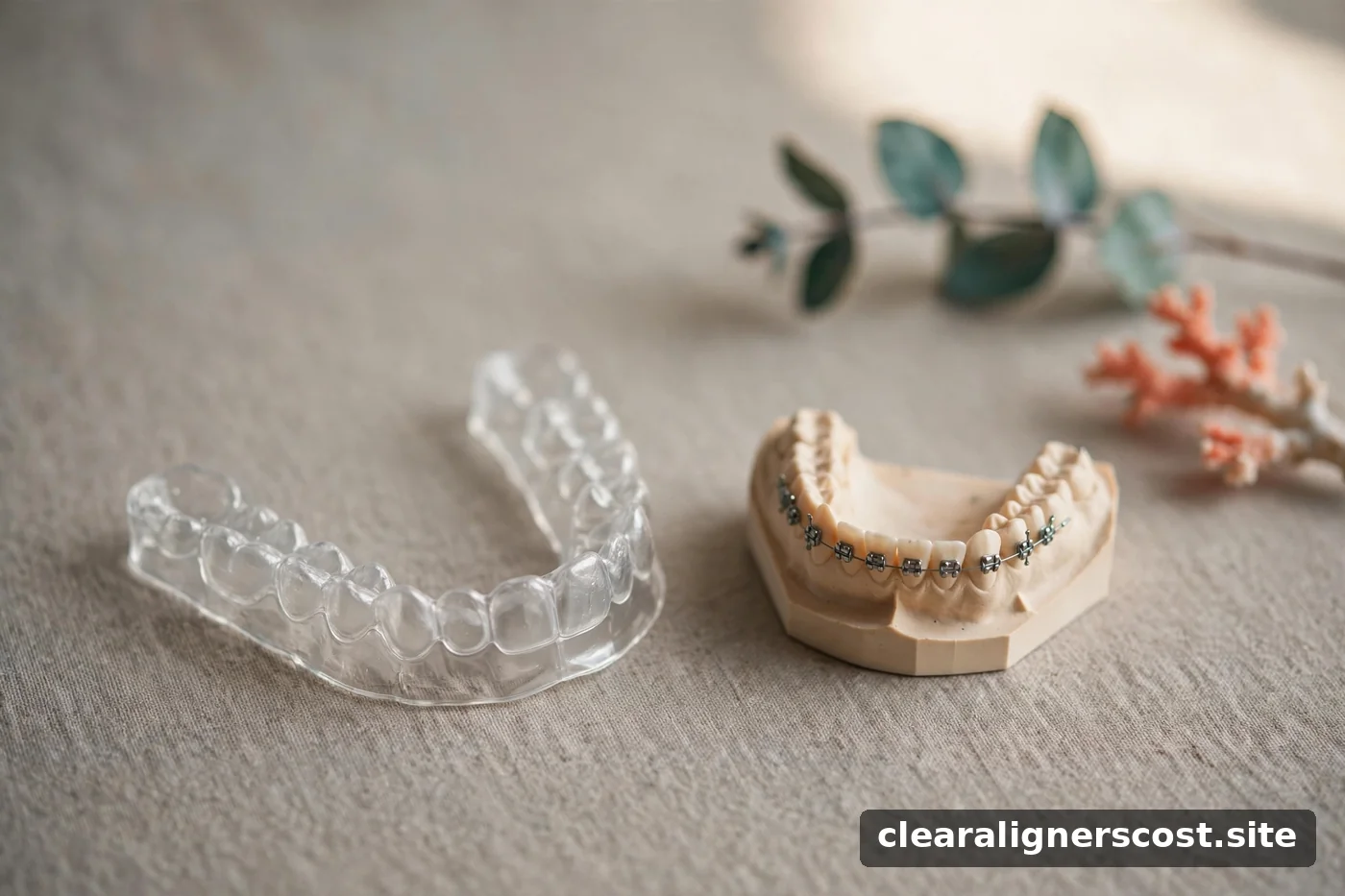
In 2026, Invisalign and traditional braces cost nearly the same: Invisalign runs $3,000–$8,500 depending on tier, while braces run $3,000–$7,000. The old rule — “braces are the budget option” — no longer holds. The real differences are about treatment mechanics, lifestyle fit, and which cases each handles best. Here’s the honest comparison, including the cases where braces genuinely win.
Key takeaways
- Cost overlap is real: braces $3,000–$7,000 vs Invisalign $3,000–$8,500 — price alone rarely decides anymore.
- Braces win on: severe bite issues, complex vertical movements, non-compliant patients, and younger kids.
- Invisalign wins on: discretion, hygiene, food freedom, comfort, and fewer emergency visits.
- The deciding question isn’t “which is better” but “which fits my case complexity and my discipline.”

Cost Comparison
| Invisalign | Traditional braces | |
|---|---|---|
| Typical range | $3,000–$8,500 | $3,000–$7,000 |
| Mild cases | Express/Lite: $1,800–$4,500 | $3,000–$5,000 |
| Comprehensive | $5,000–$8,500 | $4,500–$7,000 |
| Retainers after | $400–$1,000 (Vivera/4 sets) | $200–$600 (often Hawley or bonded) |
| Refinements | Comprehensive: unlimited in timeframe; lower tiers: $500–$2,500/round | Adjustments included in treatment |
| Emergency visits | Rare (tray issues are minor) | Broken brackets/wires: occasional paid visits |
Ranges reflect 2026 cost guides (Premieropolis, Calciflow). Note the nuance: Invisalign’s mild-case tiers (Express from $1,800) undercut braces, while its Comprehensive tier can exceed them. Insurance treats both identically — 25–50% up to the lifetime orthodontic maximum — so coverage rarely tips the choice.
Hidden-cost profile differs: Invisalign’s surprises cluster around refinements, retainers, and lost trays. Braces’ surprises cluster around extended treatment time (more paid visits if treatment runs long) and post-treatment retainers, which are still required.
Treatment Time
- Invisalign: 12–18 months average for comprehensive adult cases; 3–7 months for Express/Lite mild cases. Refinement rounds add 3–6 months each.
- Braces: 18–24 months average; complex cases can run 24–36 months.
Invisalign can be faster for mild-to-moderate cases — fewer, shorter appointments and no wire adjustments. But that speed assumes 22-hours-a-day compliance. Braces work 24/7 regardless of discipline, so their timeline is more predictable for patients with chaotic schedules. For complex cases, braces are often faster in practice because they don’t depend on patient cooperation or refinement cycles.
Side-by-Side: The Full Trade-Offs
| Factor | Invisalign | Braces |
|---|---|---|
| Visibility | Nearly invisible | Visible (ceramic less so, costs more) |
| Comfort | Smooth plastic; mild pressure when changing trays | Brackets/wires can irritate cheeks; tightening soreness |
| Eating | Remove trays; no food restrictions | No sticky/hard foods; brackets trap food |
| Hygiene | Brush and floss normally | Threaders, interdental brushes; higher cavity risk if lax |
| Appointments | Every 6–10 weeks, shorter visits | Every 4–8 weeks for adjustments |
| Emergencies | Rare | Poking wires, broken brackets happen |
| Discipline required | High — 20–22 hrs/day wear | None — always working |
| Sports/music | Removable for contact sports, wind instruments | Mouthguard needed; can interfere with instruments |
| Staining | Trays can stain if you drink coffee/tea with them in | Ceramic brackets can stain; metal doesn’t |
| Complex movements | Good; limited for severe vertical/bite issues | Gold standard for difficult mechanics |
Where Braces Genuinely Win
An honest aligner-cost site says this plainly: braces are the better clinical tool for several common situations, and choosing Invisalign there wastes money.
- Severe bite issues. Significant overbites, underbites, and crossbites (Class II/III) often need the precise, continuous force control of brackets and wires. Invisalign handles mild-to-moderate bite issues well but has real limits.
- Major vertical corrections. Open bites and deep bites requiring substantial vertical repositioning respond more predictably to braces in most cases.
- Patients who won’t comply. This is the honest one. If 22-hours-a-day wear is unrealistic for your life — constant travel, client dinners, irregular schedules — braces deliver results because they’re always working. Paying $6,000 for aligners you wear 14 hours a day is the worst value in orthodontics.
- Young children. For most Phase 1 and early comprehensive pediatric work, traditional methods remain more predictable than aligners.
- Severe rotations and extrusions. Teeth needing significant twisting or vertical pulling movements are bracket territory.
In these cases braces aren’t the “cheaper fallback” — they’re the right treatment, often at a lower or equal price.
Where Invisalign Genuinely Wins
- Professional adults. Client-facing work, cameras, public speaking — the invisibility factor is the entire value proposition, and it’s legitimate.
- Hygiene-conscious patients. Removable trays mean normal brushing and flossing. For patients with a history of decay, this is a clinical advantage, not just convenience.
- Food freedom. No banned-foods list. For athletes, foodies, or anyone who’d suffer through two years of no-popcorn rules, this matters daily.
- Comfort and emergencies. No wire-poke emergencies, no bracket breaks before a big event. Tray changes bring mild pressure for a day or two — generally milder than tightening appointments.
- Fewer, shorter appointments. Every 6–10 weeks vs every 4–8, and shorter chair time — meaningful for busy schedules.
- Mild-to-moderate cases. For straightforward crowding and spacing, Invisalign’s lower tiers ($1,800–$4,500) can genuinely undercut braces on price.
Ceramic and Lingual Braces: The Middle Ground
Metal braces and Invisalign aren’t the only options. Two variants split the difference:
- Ceramic braces work like metal braces but use tooth-colored brackets — much less visible, slightly more expensive than metal (typically toward the top of the $3,000–$7,000 braces range), and the brackets can stain if you’re a heavy coffee, tea, or curry consumer. They can also be a bit more fragile than metal.
- Lingual braces mount on the inside of the teeth — truly invisible from the front, but the most expensive braces option (often $8,000–$10,000+), harder to clean, and they can irritate the tongue and affect speech at first. Few orthodontists offer them, which limits your choice of provider.
For most patients the practical choice remains metal braces vs Invisalign. Ceramic makes sense if you want braces’ 24/7 mechanics with less visibility and can live with the staining caveat. Lingual is a niche pick for patients who need braces-level mechanics with zero visibility and have the budget for it.

The Compliance Factor Nobody Prices In
Here’s the cost dimension most comparisons skip: Invisalign’s price assumes your cooperation; braces’ price doesn’t. Research and clinical observation suggest 30–40% of aligner patients don’t consistently hit 20–22 hours of daily wear. The financial consequence arrives quietly — stalled progress, then paid refinement rounds at $500–$2,500 each.
Before choosing Invisalign, run an honest self-audit: Will you wear trays through work lunches, social events, and travel? Will you put them back in immediately after eating, every time, for a year or more? If the honest answer is “probably not,” braces’ 24/7 mechanics aren’t a compromise — they’re insurance against your own habits. There’s no shame in it; it’s the kind of self-knowledge that saves thousands.
Cost of Getting It Wrong
The most expensive outcome isn’t choosing the pricier option — it’s choosing the wrong option and paying twice:
- Invisalign for a braces case: $5,000–$8,500 spent, inadequate correction, then braces anyway. Total: potentially $10,000+.
- Braces when aligners would do: you overpay in lifestyle cost (two years of visible treatment, food restrictions) more than dollars.
- Either without retainers: teeth relapse, and retreatment costs nearly as much as the first round. Budget the $400–$1,000 for Vivera (or $200–$600 for post-braces retainers) from day one.
The cheapest path is the right diagnosis the first time. A reputable orthodontist who offers both — and recommends against their higher-margin option when it’s wrong for you — is worth more than any price comparison. Our guide to Invisalign cost tiers and full 2026 price guide help you walk into that consultation informed.
FAQ
Is Invisalign more expensive than braces?
Not necessarily anymore. Braces: $3,000–$7,000. Invisalign: $3,000–$8,500. For mild cases, Invisalign Express/Lite ($1,800–$4,500) can be cheaper than braces; for complex cases, Comprehensive Invisalign can exceed them.
Which is faster, Invisalign or braces?
For mild-to-moderate cases with good compliance, Invisalign is often faster (12–18 months vs 18–24). For complex cases or inconsistent wearers, braces are typically faster and more predictable.
Do braces or Invisalign hurt more?
Both cause soreness when teeth move. Invisalign’s is usually described as pressure for a day or two after each tray change; braces add cheek irritation from brackets and soreness after tightening appointments. Most patients rate Invisalign as the more comfortable day-to-day experience.
Can I switch from Invisalign to braces mid-treatment?
Yes, and it happens — usually when a case proves more complex than planned or compliance fails. You’ll pay for the braces treatment on top of what’s already spent, which is why honest case assessment up front matters so much.
Which is better for teens?
It depends on the teen. Responsible, self-motivated teens do well with Invisalign Teen (compliance dots help). Teens unlikely to wear trays 22 hours daily get better results from braces. Our parent’s guide covers the decision.
Do I still need retainers after braces?
Yes — absolutely. Teeth shift back toward their original positions after any orthodontic treatment, braces included. Post-braces retention usually means a bonded wire, a Hawley retainer, or clear retainers ($200–$600), worn nightly for life. Skipping retention is the most common cause of relapse, and retreatment costs nearly as much as the first round. Budget for retainers from day one, whichever treatment you choose.
Which stains less: Invisalign or ceramic braces?
Invisalign trays are swapped every one to two weeks, so staining never accumulates much — though drinking coffee or tea with trays in will discolor them fast. Ceramic brackets stay on for the full 18–24 months, so they can pick up noticeable stain over time. Metal braces don’t stain at all. If you’re a heavy coffee drinker choosing between aesthetic options, Invisalign’s frequent tray changes are the more forgiving pick.
Are payment plans available for both braces and Invisalign?
Yes — most orthodontic practices offer in-house payment plans for both, often at 0% interest for 12–24 months, plus third-party medical financing for longer terms. Braces’ lower average cost also means lower monthly payments on identical terms. Our financing guide walks through the math for comparing plans honestly.
This is general information, not medical advice — talk to your dentist or orthodontist about your situation.