
Direct answer: Invisalign Teen typically costs $3,200–$6,500 — roughly the same as comprehensive adult treatment. It includes teen-specific features like wear-time indicators and free replacement trays. The real question for parents isn’t the price, though — it’s compliance. Aligners only work if your teenager wears them 20–22 hours a day, and that’s a behavioral bet you need to make honestly.
Key takeaways
- Invisalign Teen runs $3,200–$6,500; insurance often helps more for teens since dependent orthodontic coverage is common.
- Blue wear-time indicators let parents and providers verify actual wear — use them.
- The decision hinges on your teen’s responsibility level, not on which option is trendier.
- Budget all-in: add retainers ($400–$1,000), possible refinements, and replacement-tray logistics.
- Set expectations and consequences *before* treatment starts, not after the first lost tray.
What Invisalign Teen is (and isn’t)
Invisalign Teen is not a watered-down product — it’s the full Invisalign system with features designed for adolescent patients:
What’s included:
– Treatment designed around erupting teeth — the system accounts for teeth that haven’t fully come in, with eruption tabs that hold space
– Blue compliance indicators on the trays that fade with wear, giving an objective measure of wear time
– Free replacement trays (typically up to 6) for lost or damaged aligners — because teenagers lose things
– The same SmartTrack material and attachment system as adult treatment
What it isn’t:
– Not cheaper than adult treatment in any meaningful way — the $3,200–$6,500 band overlaps heavily with adult comprehensive pricing
– Not “easier” treatment — the biology is identical; teeth move the same way at 14 as at 34
– Not appropriate for every teen case — severe bite issues, major rotations, and complex movements follow the same limitations as adult aligners
One important note: Invisalign Teen is designed for teens with most permanent teeth erupted — typically ages 13–19. Younger children with mixed dentition are usually candidates for Invisalign First (a phase-1 product, $2,000–$4,000) or traditional early treatment instead. Your orthodontist determines which product fits your child’s dental development.
The real cost breakdown
The $3,200–$6,500 national band for Invisalign Teen reflects the same drivers as adult pricing: case complexity, provider type, and geography. Here’s what parents actually spend:
| Component | Typical cost |
|---|---|
| Base Invisalign Teen treatment | $3,200–$6,500 |
| Initial records (scans/X-rays) | $150–$500 (sometimes bundled) |
| Refinements beyond included rounds | $0–$2,500 |
| Post-treatment retainers | $400–$1,000 |
| Lost-tray replacements beyond free allowance | $100–$300 each |
| Realistic all-in | $4,000–$9,000 |
The insurance advantage teens have: dependent orthodontic coverage is far more common than adult coverage. Many employer dental plans include $1,000–$3,500 lifetime orthodontic maximums for dependents under 19 — which can cut the out-of-pocket cost nearly in half. If you’re choosing plans during open enrollment, the dependent ortho benefit deserves close attention.
What to ask the provider:
– Is this quote for Invisalign Teen specifically, and what’s included?
– How many refinement rounds are included?
– How many free replacement trays are included, and what do extras cost?
– Is the retainer after treatment included?
– Do you offer a cash-pay discount or family discount (relevant if siblings will need treatment too)?
For the broader pricing landscape, our Invisalign cost tiers guide breaks down every product band, and our financing options guide covers payment plans.
The compliance question: the heart of the decision
Here’s the uncomfortable truth at the center of the teen aligner decision: the technology works beautifully for teenagers who wear it, and poorly for teenagers who don’t. And “wearing it” means 20–22 hours a day, every day, for 12–24 months — through school lunches, sports practice, sleepovers, and social life.
Be honest about your teenager. Consider:
Signs aligners will probably work:
– Responsible with belongings (doesn’t chronically lose phone, retainer, glasses)
– Follows multi-step routines without constant nagging
– Motivated by the outcome (asked for straighter teeth themselves, not just going along with it)
– Comfortable with the social aspect (removing trays at school lunch)
Signs braces might be smarter:
– Loses things regularly
– Resists routines and reminders
– Agreed to treatment mainly because you wanted it
– Plays contact sports where trays add hassle (though trays must come out for sports anyway — mouthguard rules still apply)
– Has a history of not following through on health routines
This isn’t about judging your kid — it’s about matching the treatment to the patient. An estimated 30–40% of all Invisalign patients struggle with the 20–22 hour target; teenagers, with less developed executive function and more chaotic schedules, are not the group most likely to beat that average. Choosing braces for a teen who won’t comply isn’t settling — it’s the clinically smarter call, and it’s often cheaper.
Teen-specific features that help
Invisalign built Teen around the compliance problem. These features genuinely help:
Compliance indicators. Small blue dots on the trays fade with wear. They give providers an objective read on wear time at check-ins — and give parents a verification tool. Use them as data, not as a gotcha: “the indicators show the trays aren’t being worn enough” is a conversation starter, not an accusation.
Free replacement trays. Invisalign Teen typically includes up to 6 replacement trays at no charge. Given that teens lose trays in school cafeterias with remarkable efficiency, this is real money saved — replacements otherwise run $100–$300 each.
Eruption compensation. For teens whose second molars are still coming in, the system designs around eruption rather than requiring providers to work around it manually.
Remote monitoring options. Some providers offer apps where teens submit weekly photo check-ins from home, reducing office visits — a meaningful convenience for busy families. Ask whether your provider offers this and whether it costs extra.
None of these features solve the fundamental issue — the trays still need to be in the mouth 20–22 hours — but they remove the secondary friction (lost trays, office-visit logistics, guesswork about compliance) that derails teen treatment.
Aligners vs. braces for teenagers
The head-to-head, parent to parent:
| Factor | Invisalign Teen | Traditional braces |
|---|---|---|
| Cost | $3,200–$6,500 | $3,000–$7,000 (often similar) |
| Visibility | Nearly invisible | Visible (ceramic less so) |
| Compliance needed | 20–22 hrs/day wear | None — always working |
| Lost/broken risk | Lost trays common | Broken brackets happen but stay in mouth |
| Eating restrictions | None (trays out to eat) | No hard/sticky foods |
| Sports | Trays out + mouthguard | Mouthguard over braces |
| Hygiene | Easier (brush normally with trays out) | Harder (threaders, brackets trap food) |
| Emergencies | Lost tray = call provider | Poking wire = wax + call provider |
| Best for | Responsible, motivated teens | Everyone else |
The hygiene point deserves emphasis: teenagers with braces need diligent brushing around brackets — and teen brushing diligence is famously uneven. Aligners let them brush and floss normally, which is a genuine dental-health advantage if the trays go back in afterward.
The social point is real but often overstated. Teens care enormously about appearance, and aligners win on discretion. But braces are utterly normalized in middle and high school — nobody is socially penalized for them. Don’t let the cool factor override the compliance calculus.
Our full Invisalign vs. braces comparison covers the clinical differences in depth.

The parent framework: deciding well
A practical decision process:
Step 1: Get the clinical picture. At the consultation, ask: Is my teen’s case mild, moderate, or complex? Are there movements here that aligners handle poorly? Would braces give a meaningfully better result? Get the itemized quote with refinements and retainers specified.
Step 2: Assess your teen honestly. Use the compliance signals above. Better yet, involve your teen in the assessment — “this only works if you wear them 20+ hours a day, including at school” — and watch their reaction. Genuine buy-in predicts success; reluctant agreement predicts lost trays.
Step 3: Run the money. Get the all-in quote, subtract the verified insurance benefit (get a pre-treatment estimate in writing), and compare against braces quotes. Factor in HSA/FSA funds — orthodontics for dependents is an eligible expense. Our HSA/FSA guide explains the tax savings.
Step 4: Set the terms upfront. Before treatment starts, agree with your teen on: tray-wear expectations, what happens with lost trays (who pays beyond the free replacements?), and check-in accountability. Written or verbal, the conversation matters more than the format. Teens who understand the stakes comply better than teens who were simply told to wear them.
Step 5: Choose the provider, not just the product. For teen cases especially, provider experience with adolescents matters — they spot compliance problems early and manage teen psychology well. Ask how many teen cases the provider handles annually.
Managing treatment day to day
Once treatment starts, parents play a supporting role:
The first two weeks are the adjustment period — mild soreness with each new tray, awkwardness removing trays at school. Most teens adapt quickly. Soft foods and patience help.
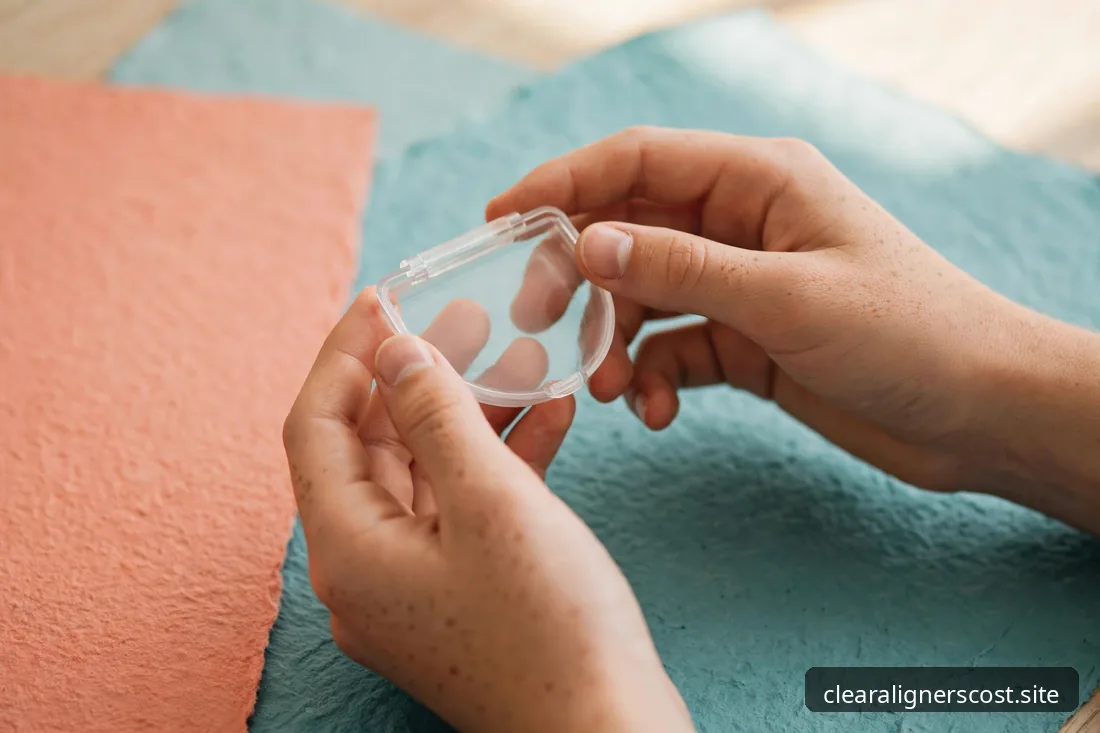
School logistics: your teen needs a tray case in their backpack (never a napkin — cafeteria trash claims thousands of trays yearly), and a plan for lunch: remove, eat, quick brush or rinse, reinsert. A travel toothbrush in the backpack solves most of it.
Sports: trays come out for all sports, replaced by a proper mouthguard. This is non-negotiable — a stray ball plus aligners is a dental emergency.
Check the indicators at tray-change time. Fading blue dots confirm wear; unfaded dots mean a conversation — ideally curious rather than punitive. Often the fix is practical (forgot at school, lost track of time) rather than defiant.
Don’t police every hour. Teens who feel surveilled tend to comply less, not more. Set the expectation, verify at check-ins, and let the provider be the authority on wear time — it lands better coming from the orthodontist than from a parent.
Plan for the retainer phase from the beginning. Treatment ends; retention is forever. Teens who’ve worn aligners for a year usually transition to nightly retainers without drama — but budget the $400–$1,000 and make it part of the original financial plan, not a surprise later. Our retainer guide has the lifetime math.
FAQs
How much does Invisalign Teen cost without insurance?
Typically $3,200–$6,500 for the base treatment, with realistic all-in totals of $4,000–$9,000 once retainers, refinements, and records are included.
What age is best for Invisalign Teen?
Generally 13–19, once most permanent teeth have erupted. Maturity matters as much as dental development — a responsible 13-year-old often does better than a careless 16-year-old.
What happens if my teen loses aligners?
Invisalign Teen includes free replacement trays (usually up to 6). Beyond that, replacements cost $100–$300 each. The standard interim step: wear the previous tray to hold progress while the replacement is made.
Can teens really wear them 22 hours a day with school and sports?
Yes — millions do. Trays come out for meals and sports only, which fits within the 2–4 hour daily budget. The challenge is habit, not schedule.
Is Invisalign or braces better for a 14-year-old?
It depends on the case and the kid. Aligners win on discretion and hygiene for compliant teens; braces win on guaranteed progress for everyone else. An honest orthodontist will tell you which category your teen falls into.
Does insurance cover Invisalign for teens?
Often yes — dependent orthodontic benefits ($1,000–$3,500 lifetime maximums) are common in employer dental plans. Verify with a pre-treatment estimate before starting.
This is general information, not medical advice — talk to your dentist or orthodontist about your situation.