
The honest answer: Invisalign doesn’t hurt the way most people fear, but it’s not sensation-free either. Expect pressure and soreness — most noticeable in the first 2–3 days after switching to a new set of trays — that fades as your teeth adjust. Most patients describe it as discomfort or tenderness rather than pain, and it rarely interferes with daily life.
That said, “everyone’s experience differs” isn’t a dodge here — it’s the truth. Pain tolerance, case complexity, and tray-change timing all shift the experience. This guide gives you the realistic spectrum, practical tips that actually help, and the red flags that mean “call your provider” instead of “wait it out.”
Key takeaways
- Expect **pressure and soreness for 2–3 days** after each new tray — most patients call it uncomfortable, not painful.
- **Switch to new trays at night** so the sorest hours happen while you sleep.
- Cold water, soft foods, and proper tray seating ease the adjustment period.
- **Sharp, localized, or worsening pain** is not normal — call your provider rather than waiting it out.
- Compared with braces, Invisalign generally means **less mouth irritation** (no wires or brackets) but a recurring adjustment cycle with every tray.

The short answer
Invisalign works by applying gentle, continuous pressure to move teeth — and pressure registers as soreness. The pattern most patients report: each new tray feels tight and makes teeth tender for 2–3 days, especially when biting. Then the sensation fades, the tray starts feeling loose (a sign it’s done its job), and the cycle repeats with the next set.
Overall, Invisalign is widely considered more comfortable than traditional braces — no metal brackets rubbing cheeks, no wire pokes, no tightening appointments. But “more comfortable than braces” still includes real, recurring soreness. Going in expecting zero sensation sets you up for unnecessary worry; expecting manageable, cyclical tenderness sets you up accurately.
What it actually feels like
Patients describe the sensation in consistent terms:
- Pressure. A dull, even tightness across the teeth — like they’re being gently squeezed. This is the primary sensation and it’s actually the feeling of the treatment working.
- Tenderness when biting. The first day or two of a new tray, biting into anything firm can zing. Teeth feel slightly loose or “bruised” — that’s normal tooth-movement physiology, not damage.
- Mild aching. A background ache, usually worst in the evening of day one, that responds to the usual comfort measures.
- Gum and tongue irritation. New tray edges can rub for a day until your mouth adapts or the edge is smoothed. Attachments add small bumps your tongue will investigate relentlessly for the first week.
What it generally does not feel like: sharp stabbing pain, throbbing that keeps you awake, or pain concentrated in a single tooth that worsens over days. Those are outliers — covered in the red-flags section below.
The first tray is the worst. Not because it’s engineered differently, but because everything is new — the pressure, the plastic, the attachments, the routine. Patients consistently report that tray one is the most uncomfortable and every subsequent tray is easier, partly because the movements get smaller and partly because you know what to expect.
The tray-change cycle
Understanding the rhythm removes most of the anxiety (on how wear compliance drives outcomes and costs). A typical cycle with weekly tray changes:
- Day 1 (change day): New tray feels tight. Teeth are tender; stick to soft foods. This is the peak.
- Days 2–3: Soreness fades to mild tenderness. Normal eating resumes for most people.
- Days 4–7: Tray feels progressively looser — it’s done most of its programmed movement. You might forget you’re wearing it.
Then the next tray resets the cycle, usually milder than the last. Over months, the pattern becomes background routine rather than an event.
Change timing matters: switch to new trays at night before bed. You’ll sleep through the first 6–8 hours of peak tightness instead of experiencing them at work. This single habit is the highest-value comfort tip in Invisalign treatment, and it costs nothing.
Attachments, IPR, and extras
A few treatment elements have their own sensation profiles:
- Attachments (the small tooth-colored buttons) don’t hurt, but new trays click over them with noticeable pressure for the first day. Your tongue will also obsess over them for about a week. Both fade. Full explainer: Invisalign attachments.
- IPR (slenderizing between teeth) involves vibration and pressure but no pain — enamel has no nerves. Any sensitivity afterward is mild and brief.
- Elastics or buttons for bite correction, if your plan includes them, add a new pressure vector and their own 2–3 day adjustment period — same pattern, different direction.
- Chewies (small foam cylinders you bite on to seat trays fully) can make teeth ache briefly after use. That ache means the tray is seating properly — bite gently, not aggressively.
None of these change the overall picture: cyclical, manageable, fading soreness — not escalating pain.
What helps: practical relief tips
These are the measures patients and providers actually rely on — no gimmicks:
- Change trays at night. Worth repeating: sleep through the worst of it.
- Cold water and cold foods. Cold dulls the ache — ice water, smoothies, and yogurt are the classic day-one menu. Avoid very hot foods and drinks when teeth are tender; temperature sensitivity is temporarily higher.
- Soft foods for the first 2–3 days. Soups, eggs, pasta, fish, mashed vegetables. Save the crusty bread and raw carrots for day four.
- Seat trays fully with chewies. A poorly seated tray concentrates pressure unevenly, which hurts more than a well-seated one. A minute of gentle chewing on a chewie after inserting new trays distributes the force.
- Orthodontic wax for rub spots. If a tray edge irritates your cheek or tongue, a dab of orthodontic wax (or a nail file’s gentle pass on the edge, done carefully) solves it. Don’t tolerate a rubbing edge for a week — fix it on day one.
- Keep the wear schedule. Paradoxically, taking trays out “to rest” your teeth prolongs soreness — each reinsertion restarts the pressure cycle. Consistent wear gets you through the tender phase faster.
- Over-the-counter pain relief as directed. Many patients use standard OTC pain relievers per the label for the first day or two of a new tray. If you have medical conditions or take other medications, check with your pharmacist or doctor first — this is general information, not a recommendation for you specifically.
- Warm salt-water rinses can soothe irritated gums and minor mouth sores from tray edges.
What about the timeline — when does it stop? For most patients, meaningful soreness is confined to the first few days of each tray, and the overall intensity trends downward as treatment progresses. If you’re months in and every tray still hurts badly, that’s worth mentioning at your next checkup — it can signal a tracking problem rather than normal adjustment.
Curious how this fits into the full journey? Our treatment process guide walks through every stage from consult to retainers.
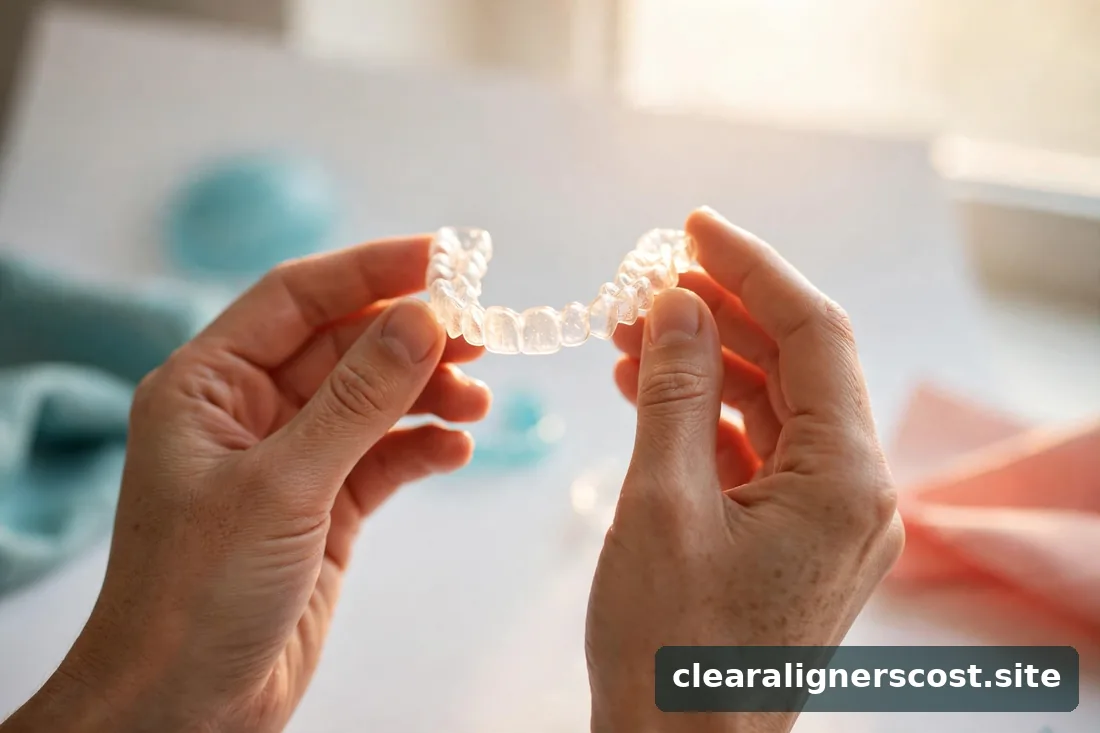
What doesn’t help (or makes it worse)
- Skipping wear time to “rest.” As noted, inconsistent wear stretches out every tender phase and risks the tray not fitting — which creates worse problems than soreness.
- Changing trays early to “get it over with.” Teeth need the full programmed time per tray. Rushing the schedule doesn’t shorten total treatment; it derails it.
- DIY tray modifications. Filing, trimming, or bending a tray to relieve a pressure spot changes the force system unpredictably. A pressure spot that concerns you is a message for your provider.
- Chewing hard foods on day one to “test” the new tray. You’ll find out the tray is tight — painfully, and for no benefit.
- Ignoring a bad edge. A tray edge that’s actually sharp (not just new-feeling) won’t “break in” — smooth it or wax it on day one.
When to call your provider
Normal soreness is diffuse, cyclical, and fading. Call your provider — don’t wait for the next scheduled checkup — if you experience:
- Sharp or severe pain in a specific tooth, especially if it’s worsening rather than fading after 3–4 days
- A tray that won’t seat — rocking, lifting off, or leaving a gap over one tooth that previous trays didn’t have (possible tracking problem)
- Sores or ulcers from tray edges that don’t improve within a few days of wax/smoothing
- An attachment that fell off — keep wearing trays, but get it re-bonded; the tooth isn’t getting its programmed force without it
- Swelling, bleeding gums, or signs of infection around any tooth
- An allergic reaction — itching, rash, or swelling of lips/tongue after inserting trays (rare, but real)
- A cracked or broken tray — don’t wear a damaged tray; wear the previous set and call for guidance
The threshold is simple: soreness that follows the normal cycle (peaks day 1–2, fades by day 4) is treatment working. Pain that breaks the pattern — sharper, longer, localized, or worsening — is information your provider needs. You’re not bothering them; triaging this is literally what checkups and on-call lines are for.
FAQ
Does Invisalign hurt more than braces?
Most patients report less overall discomfort with Invisalign — no brackets, wires, or tightening appointments. Braces pain tends to spike after adjustments; Invisalign discomfort is milder but recurs with each new tray.
How long does Invisalign pain last with each new tray?
Typically 2–3 days of noticeable soreness, fading over the first week. Changing trays at night lets you sleep through the worst of it.
Why do my teeth feel loose with Invisalign?
Slight mobility during active tooth movement is normal physiology — teeth move through bone remodeling, which temporarily loosens them. They firm up again, especially once retainers take over. If a tooth feels dramatically loose, call your provider.
Do the first trays hurt the most?
Usually yes — everything is new and the initial movements are often the largest. Most patients find subsequent trays progressively easier.
Can I take painkillers for Invisalign pain?
Many patients use over-the-counter pain relief as directed on the label during the first day or two of a new tray. Check with your pharmacist or doctor if you have other conditions or medications — and mention persistent pain to your orthodontist rather than masking it indefinitely.
Is it normal for new trays to not hurt at all?
Yes — some tray changes produce barely any sensation, especially later in treatment when movements are small. No pain doesn’t mean no progress.
This is general information, not medical advice — talk to your dentist or orthodontist about your situation.