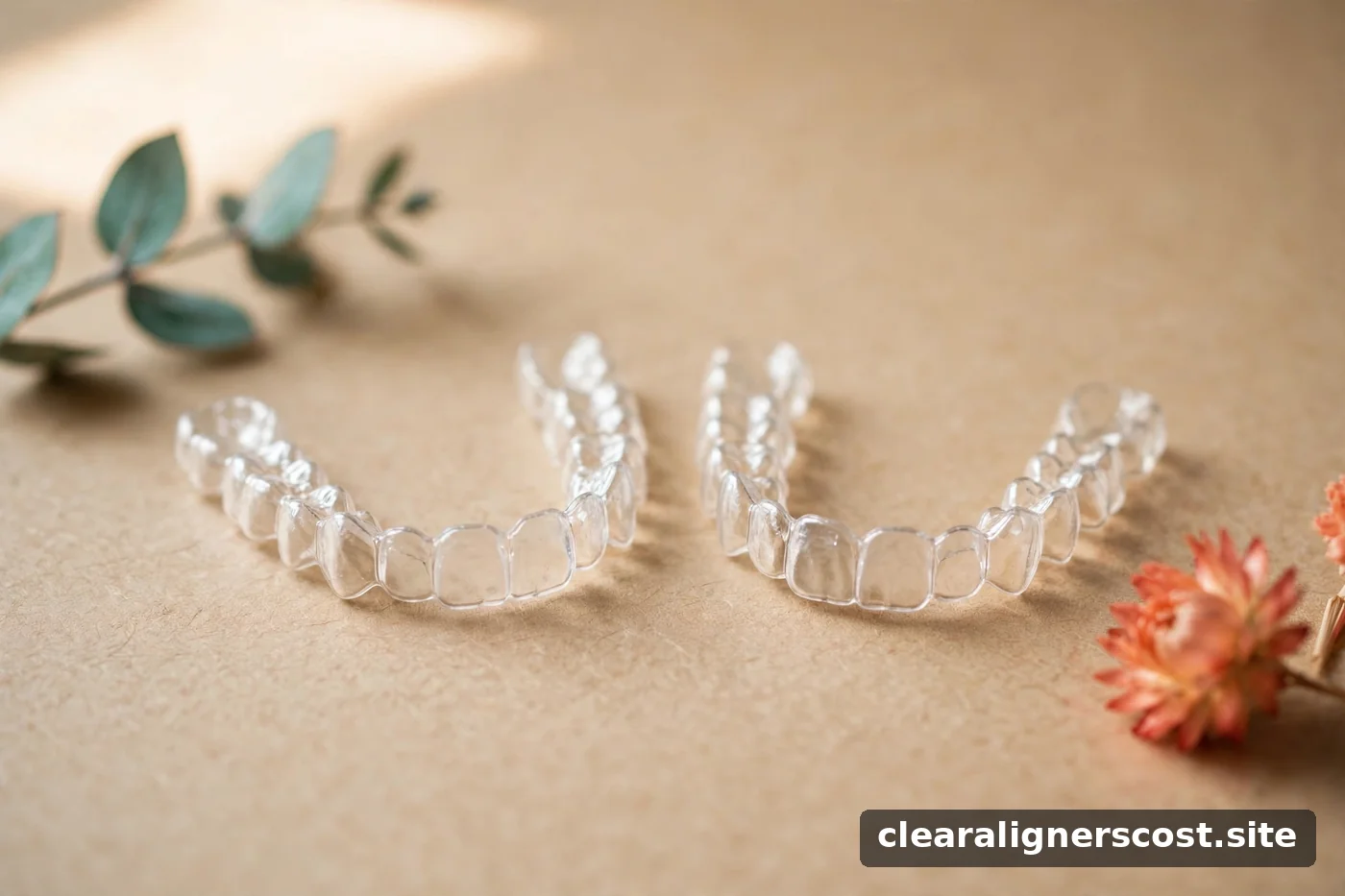
Candid’s clear aligners cost ~$2,100 upfront (about $2,400 on their payment plan), versus $3,000–$8,500 for in-office Invisalign. Candid’s pitch is a hybrid: remote treatment planned by licensed orthodontists, with the option of in-person 3D scans at 25+ studio locations. The honest difference isn’t just price — it’s scope of treatment and depth of supervision. Here’s how they compare, and who each one actually suits.
Key takeaways
- Candid: ~$2,100 upfront or ~$2,400 on the plan ($299 down + $79/month); average treatment ~6 months.
- Invisalign: $3,000–$8,500; 12–18 months average; in-person orthodontist with X-rays, attachments, and hands-on monitoring.
- Candid’s hybrid edge: 25+ studio locations for in-person scans plus remote orthodontist oversight — more touch than pure mail-order brands.
- Candid suits mild-to-moderate cosmetic cases; Invisalign suits anything involving bite correction, complex movement, or attachments.
Price Comparison
| Candid | Invisalign | |
|---|---|---|
| Upfront price | ~$2,100 | $3,000–$8,500 (tier-dependent) |
| Payment plan | ~$2,400 total ($299 down + $79/mo × 36 mo) | In-house: $500–$1,000 down + $150–$300/mo |
| Impression kit / scan | $95 at-home kit, or free scan at 25+ studios | Varies by provider (scans $150–$500) |
| Retainers | $99 per set | First set often free; Vivera $400–$1,000/4 sets |
| Refinements | Per plan terms | Comprehensive: unlimited within timeframe |
| Average treatment time | ~6 months | 12–18 months |
Pricing compiled from published brand pricing via FinvsFin’s comparison and 2026 Invisalign cost guides. Candid’s plan premium is modest — about $300 over upfront — which is friendlier than most at-home financing markups (see Byte’s ~$860 plan premium).
How Candid’s Process Works
- Candidacy check — an online survey about your teeth, spacing, crowding, and dental history.
- Teeth modeling — your choice: a $95 at-home impression kit, or a walk-in 3D scan at one of 25+ Candid studio locations. The in-person scan option is Candid’s real differentiator among remote brands — a digital scan is more accurate than putty impressions.
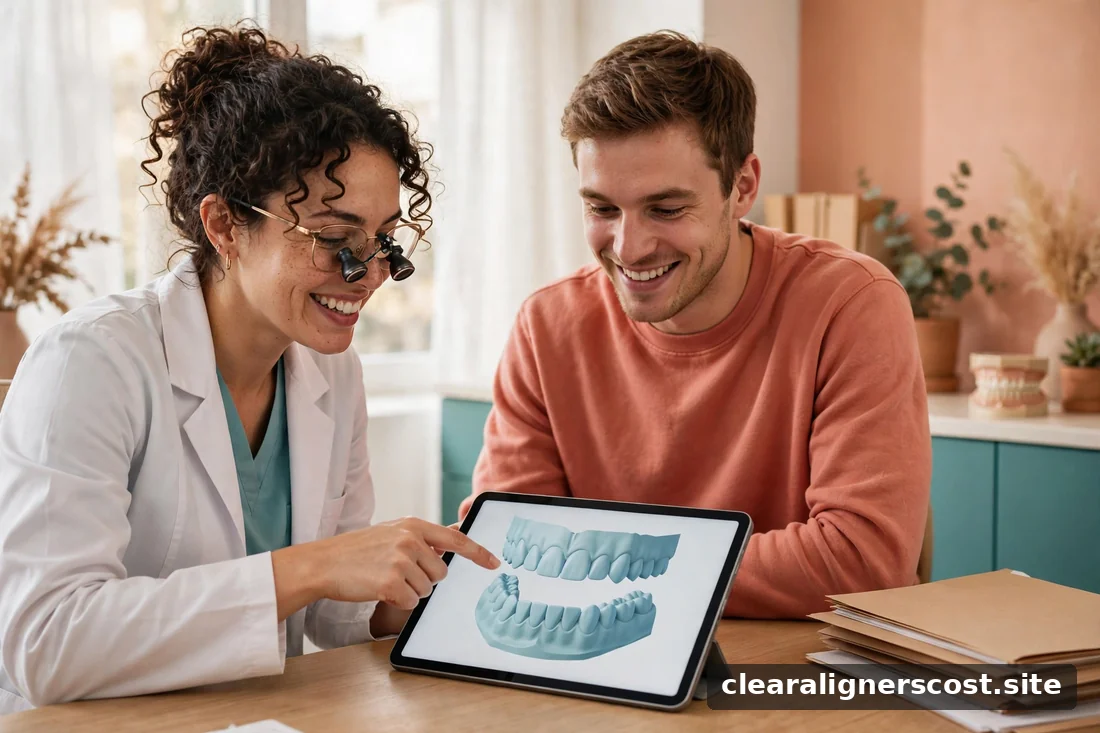
- Orthodontist-designed plan — a licensed orthodontist reviews your model and builds the treatment plan; you approve a 3D preview of your projected smile before anything ships.
- Aligners by mail — your full treatment series ships at once; you progress through trays at home.
- Remote monitoring — check-ins are handled online by Candid’s orthodontic team, with support if something feels off.
Candid positions itself for mild-to-moderate cases — a step beyond the “very mild only” scope of the cheapest mail-order brands, but still short of full orthodontic treatment. Candid also notes a charitable angle: $25 donated to Smile Train per set sold, funding cleft-palate treatment for children.
How Invisalign’s Process Works
- In-person consultation — exam, X-rays, and a 3D digital scan at the orthodontist’s or dentist’s office.
- Clinician-designed plan — your provider (orthodontist or certified dentist) designs tooth movements, including attachments, IPR, or elastics where needed.
- In-office tray delivery and monitoring — regular check-ins (typically every 6–10 weeks) where the provider physically verifies tracking and adjusts the plan.
- Refinements as needed — additional trays ordered mid-treatment; unlimited within the timeframe on Comprehensive plans.
- Retainers and retention — first set often included; ongoing retention plan from your provider.
The structural difference: an Invisalign provider sees your roots, bone, and bite in person, can place attachments for difficult movements, and can intervene physically when teeth don’t track. That’s what the extra $3,000–$6,000 buys. (Full tier details: Invisalign cost tiers explained.)
Side-by-Side Comparison
| Factor | Candid | Invisalign |
|---|---|---|
| Supervision | Remote orthodontist + optional studio scan | In-person orthodontist/dentist throughout |
| Initial imaging | Impression kit or studio 3D scan | In-office X-rays + 3D scan |
| Attachments | No | Yes — key for complex movements |
| Case scope | Mild to moderate | Mild to complex, incl. bite correction |
| Treatment length | ~6 months average | 12–18 months average |
| In-person visits | Optional (studios) | Required, ongoing |
| Cost | ~$2,100–$2,400 | $3,000–$8,500 |
| Best for | Self-directed patients, cosmetic goals | Bite issues, complex cases, hands-on care |
The Hybrid Model, Honestly Assessed
Candid’s hybrid positioning deserves a fair read. The studio scan option genuinely improves on pure mail-order: a professional 3D scan beats a self-taken putty impression for accuracy, and having a physical location to visit adds accountability. Remote orthodontist review of every case is also a real clinical layer — these aren’t unsupervised trays.
But “hybrid” has limits worth stating plainly:
- Remote monitoring is still remote. Photo check-ins can’t replicate a provider physically checking how trays seat, measuring attachment engagement, or spotting gum issues chairside.
- No attachments, no IPR. The toolkit is aligners alone, which caps what tooth movements are achievable — hence the mild-to-moderate scope.
- You’re still the project manager. Remembering wear time, noticing tracking problems, and flagging concerns falls on you far more than in an office where the provider catches issues at check-ins.
Candid is best understood as the most supervised remote option, not as a substitute for in-office orthodontics. For the full spectrum of remote vs in-person trade-offs, see at-home vs in-office aligners.
Candid’s Pricing Fine Print
Candid’s headline — ~$2,100 upfront — is straightforward, but a few line items deserve a close read before you commit:
- The impression kit ($95) is credited or refunded if their orthodontist review finds you’re not a candidate. That’s a fair policy — but confirm the current terms at checkout, since promo pricing changes.
- The payment plan (~$2,400 total) breaks down as $299 down plus $79/month. Note the plan stretches 36 months — well beyond the ~6-month average treatment time. You’ll be paying for Candid long after your trays are done. That’s normal for medical financing, just go in with eyes open.
- Retainers ($99/set) are an ongoing cost, not a one-time purchase. Teeth shift back without lifetime retention, so budget for a new set every year or two indefinitely.
- Refinement terms are per-plan — ask exactly how many refinement rounds are included and what additional rounds cost before you approve your 3D smile preview. This is the line item most likely to surprise remote-brand patients.
- The 3D preview is a projection, not a promise. It shows the planned outcome if everything tracks perfectly. If your teeth don’t track, the plan changes — which is precisely when the refinement terms above start to matter.
None of these are hidden traps; they’re standard remote-orthodontics economics. But the patients who feel burned are almost always the ones who didn’t read these five lines. Ten minutes here can save a $1,000 surprise later.
Who Candid Suits
- Mild-to-moderate crowding or spacing with an otherwise healthy bite
- Good oral health, no untreated decay or gum disease, no permanent retainers complicating the plan
- Self-directed patients comfortable managing wear time and flagging issues remotely
- Budget-conscious patients who want more oversight than the cheapest mail-order brands offer
- People near a Candid studio who’ll actually use the in-person scan
Before ordering: get a routine dental checkup first. No remote screening replaces an in-person exam for ruling out the decay, gum disease, or bone issues that make tooth movement risky.
Who Invisalign Suits
- Any bite correction (overbite, underbite, crossbite, open bite)
- Moderate-to-severe crowding, significant rotations, or complex multi-directional movement
- Cases needing attachments, IPR, or elastics
- Patients who want (or need) a clinician physically monitoring progress
- Teens, or anyone whose compliance with 22-hour wear is uncertain
- Anyone whose case a remote brand has already rejected — that’s useful diagnostic information
The price gap is real, but so is the capability gap. Paying $2,100 for treatment that can’t fix your bite, then paying $6,000 for Invisalign afterward, is the most expensive path of all. When in doubt, the in-person consultation (often free or low-cost) is the cheapest information you’ll buy in this process.
FAQ
Is Candid cheaper than Invisalign?
Yes — substantially. ~$2,100 upfront vs $3,000–$8,500 for Invisalign. But they’re priced for different scopes: Candid covers mild-to-moderate cosmetic cases, while Invisalign covers the full range including bite correction.
Is Candid as good as Invisalign?
For mild-to-moderate cases within Candid’s scope, its orthodontist-designed plans and studio-scan option make it a credible remote choice. For complex cases, they’re not comparable — Invisalign’s in-person supervision, attachments, and refinement capacity handle what remote treatment can’t.
Does Candid use real orthodontists?
Yes — Candid states that licensed orthodontists review cases and design treatment plans, with remote monitoring during treatment. The distinction from Invisalign isn’t the credential; it’s the absence of in-person exams, X-rays, and hands-on monitoring.
How long does Candid take vs Invisalign?
Candid averages ~6 months; Invisalign averages 12–18 months. Shorter isn’t automatically better — it reflects narrower case scope, not faster technology.
What if Candid rejects my case?
Take it seriously. It usually means your case needs capabilities remote treatment doesn’t offer (attachments, bite correction, in-person monitoring). Book an in-person orthodontic consultation — many are free.
Does Candid treat bite problems?
Candid is designed for mild-to-moderate alignment issues, not bite correction. If your case involves an overbite, underbite, or crossbite that needs correcting — rather than just cosmetic straightening — a remote plan without attachments or in-person monitoring isn’t the right tool. An in-office orthodontist can tell you in a single consultation whether your bite needs treatment or just your alignment does.
Can I use dental insurance or HSA/FSA funds with Candid?
Sometimes. If your dental plan includes an orthodontic benefit, it may reimburse part of remote treatment — but many plans require in-network, in-person providers, so verify before you buy. HSA and FSA funds can generally be applied to Candid since it’s orthodontic care. See our insurance guide and HSA/FSA guide for the details.
Can I visit a Candid studio if I started with the impression kit?
Candid’s 25+ studio locations offer in-person 3D scans as an alternative to the at-home impression kit. If you’ve already started with the kit, ask their support whether a studio scan can supplement your case file — policies vary. The broader point stands: if you live near a studio, using it from the start gets you the most accurate initial model, and everything else in treatment is built on that foundation.
This is general information, not medical advice — talk to your dentist or orthodontist about your situation.